Kala Bagai Was Not "Trapped" - She Traveled Freely Between the U.S. and India
The Smithsonian Learning Lab's portrayal of Kala Bagai overlooks critical archival evidence, including her husband's role as a British intelligence informant and the family's economic mobility, resulting in a fundamentally inaccurate public narrative.
The Smithsonian Learning Lab describes
Kala Bagai as:"unaccepted by her new country yet legally unable to travel back to her homeland, was trapped by her race, gender, lack of wealth, and lack of nationality."
But historic documentation shows the opposite:
- She returned to India in 1919 with two sons.
- She re-entered the U.S. in 1921.
- She moved between continents with ease.
- Her family's wealth and British ties enabled international travel at the peak era of anti-Asian laws in the United States, especially on the West Coast.
- She was a daily stock market investor.
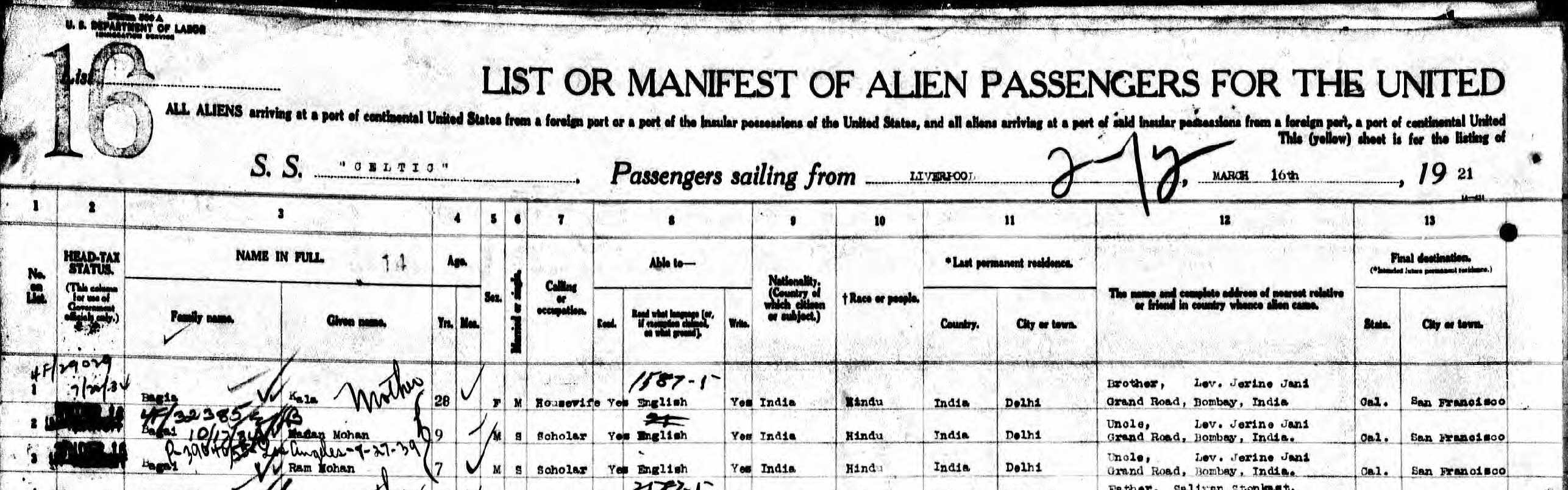
The Smithsonian Learning Lab's framing reflects a modern hardship narrative, not the documented reality of her mobility.
Note:
Through direct communication with the author, we have learned that the Smithsonian Learning Lab entry was assembled from a pre‑research packet rather than independently verified archival sources. Notably, when our team reached out to several authors who had written articles about Kala Bagai, those who responded confirmed that they too had been asked to write about her and were given fully assembled research packets and access to the Bagai family’s living descendants. Most accepted the information as accurate rather than independently verifying it. At least one local activist also shared that she had been instructed by Mrs. Ghosh to speak at various events promoting the Kala Bagai narrative, despite not being familiar with the documented historical record.
Online articels, along with the Smithsonian Learning Lab entry, are repeatedly cited by the Wikipedia page on Kala Bagai, which is heavily and consistently edited by Anirvan Chatterjee, co-host (and husband of Barnali Ghosh) of the Berkeley South Asian Radical History Walking Tour. This circular citation loop has allowed a single unverified narrative package to circulate widely, creating the appearance of scholarly consensus without archival validation.